 PCR Tech and IT retail, distribution and vendor news
In a sector dominated by legacy systems and incremental improvements, Enakta Labs is a small but ambitious player intent on reshaping how high-performance storage is deployed and managed. Founded in 2023 by Denis Nuja and Denis Barakhtanov, the company sits at the point where open‑source development meets enterprise usability, with a focus on the Distributed Asynchronous Object Storage (DAOS) project.
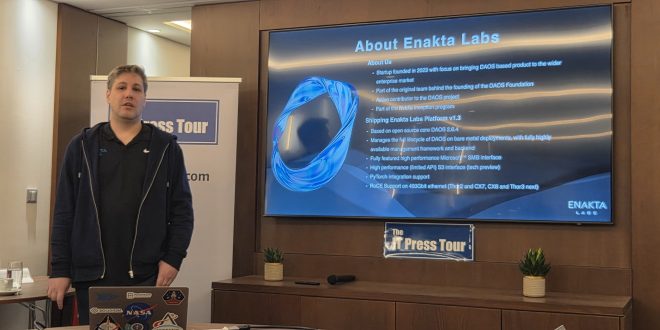
Recently, Nuja outlined Enakta Labs’ trajectory, its role in the DAOS Foundation, and the challenges of transforming a research-driven storage engine into a product capable of meeting the demands of supercomputing, artificial intelligence, and enterprise workloads.
Nuja and Denis Barakhtanov had worked on DAOS since 2020 in prior companies before embarking on the Enakta Lab journey. “We were founded in 2023, so not that long ago, and are part of the original team behind the DAOS Foundation,” Nuja explained. “We’ve been very quiet about our last few years because we were effectively in R&D.”
DAOS was conceived some ten years ago within Intel as a high-performance storage system designed to support exascale computing projects funded by the US government. Its most prominent deployment today is Aurora, the supercomputer at Argonne National Laboratory, which runs a thousand-node DAOS cluster and currently holds performance records for storage systems worldwide. When Intel exited the storage business, responsibility for DAOS shifted to the DAOS Foundation, with Hewlett Packard Enterprise’s Cray division taking over the core development team. Enakta Labs, though small, was among the founding contributors.
Nuja was candid about the challenges of building on DAOS. “We are an active contributor to the DAOS core, and we also work a lot on enabling DAOS to be used outside of Aurora, which is the biggest DAOS installation currently in the world,” he said. “We manage the full lifecycle of DAOS, from provisioning bare metal to running it in production to managing it and more. The management framework is highly accessible, and everything is properly set up so that DAOS can actually be used in an enterprise, not just with somebody that really likes GitHub and compiling.”
This captures both the technical ambition and the practical frustration of open‑source storage projects. DAOS, like Ceph or Lustre before it, offers extraordinary performance potential but requires expertise and patience to deploy. Enakta Labs’ mission is to make it usable for enterprises without the need for heroic engineering efforts. “We want to make a fast storage engine that is both usable and simple,” Nuja said.
The company’s platform, now at v1.3, integrates DAOS with familiar interfaces such as SMB and S3, developed in partnership with Tuxera. For media and entertainment customers, the SMB stack is critical, while the S3 interface, currently in technical preview, addresses demand from cloud‑native users. Nuja emphasised that performance remains the defining characteristic. “DAOS is fast. That’s its priority. Everything else behind it is up for discussion, but not the speed,” he said.
That speed is not just theoretical. In supercomputing environments, where GPUs can sit idle waiting for data, the ability to checkpoint memory quickly translates directly into financial efficiency. Nuja said. “Our system can save (checkpoint) memory at full hardware speeds,” said Nuja, “so clusters of any size avoid wasted time and money.”
The company has also invested in resilience. Traditional distributed storage systems can take days to recover from node failures. Enakta Labs claims DAOS can rebuild at network speed. “If we lose a node, we can recover that node at the speed of the network connection,” Nuja explained. “We actually tested it on a relatively common crash that we have, and we can recover a failed node in under 10 minutes. In some cases, depending on the fill rate, it could be just a few minutes. We have a case where a node failed, everything was recovered and rebuilt before the customer even noticed that there was an alert.”
The company’s approach is pragmatic: focus on NVMe, Ethernet, and widely available hardware rather than waiting for exotic technologies like CXL to mature. “Our idea was, let’s just keep to the basics. Let’s make NVMe as fast as possible,” Nuja said. “There are now some movements with some NVMe vendors where we can effectively use the TLC NVMe differently, kind of like a pseudo- SLC. Yes, we lose capacity, but we gain some lower latency and improved performance.”
Interfaces, integration, and philosophy
Beyond performance, Enakta Labs is working on interfaces that make DAOS accessible to developers and scientists. The company has built direct integration with PyTorch, funded by Google, allowing machine learning workloads to use DAOS natively for datasets and checkpointing. “They wanted to be able to use DAOS natively from inside PyTorch, not deal with mounts or anything, but use it as a dataset connection and checkpointing interface,” Nuja said. “So, we developed the full integration. This was done for Google, actually. So, Google financed this development, and we open-sourced this so anybody using open-source data can use that integration.”
That openness reflects the company’s philosophy. Enakta Labs is not chasing investors or marketing campaigns, but is focusing on building systems with and for customers. “We don’t want 400-page contracts. We think storage should be easy and simple, not exciting. If you’re excited about storage, that means that something went wrong, usually, and if something goes wrong with storage, you have problems,” Nuja said. “Our pricing is straightforward with no weird things. We work for our customers, not investors.”
The company remains small, with just five employees, but Nuja sees that as an advantage in responsiveness. With founders based in different time zones, Nuja in the UK and his partner in Australia, the team can provide round-the-clock support. “If you have any support questions at 3am, we’ll pick up the phone, and we’ll sort it out,” he said.
The broader context is that DAOS is still a relatively young project, around eight years old, and was built for a specific purpose: exascale computing. Turning it into a general-purpose enterprise storage product requires sustained engineering. Enakta Labs is betting that the demand from AI and machine learning workloads, as well as traditional HPC, will justify the effort.
“Do you want to scale to supercomputer-sized systems? You would not believe how many people actually do want to do that,” Nuja observed. “The information that I get from other people is that a lot of other systems have big problems with scaling, because it’s one thing to run a 100-node system and quite another to run a 1000-node system. The number and the types of problems that we see on a 1000-node system are very, very different from a 100-node system.”
For a business that began by searching expired domain names for its company name, Enakta Labs has quickly become part of a global conversation about the future of storage, with its mission to make DAOS usable beyond the rarefied world of government-funded supercomputers. Whether it can scale its team and customer base to match that ambition remains to be seen, but Nuja’s presentation showed a clear commitment to practical engineering and customer-focused development.
Nuja’s and Barakhtanov’s experience, combined with a willingness to tackle the complex problems of performance, resilience, and usability, may indeed give Enakta Labs a distinctive role in the evolving landscape of high-performance storage.