 PCR Tech and IT retail, distribution and vendor news
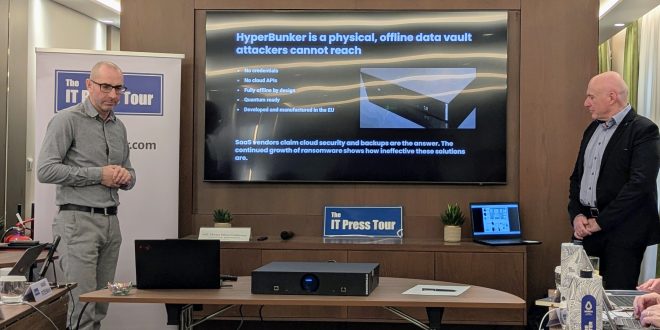
“In today’s world, one of the most important things is data, especially critical data, and we must preserve it at any cost,” said CEO of HyperBunker, Bostjan Kirm.
The company’s story begins not in cybersecurity, but in data recovery. Imran Nino Eškić, HyperBunker’s CTO and founder of the product, has spent more than 25 years in recovery laboratories in Italy and Croatia, handling over 50,000 cases. That experience shaped a perspective distinct from the mainstream cybersecurity industry. “We don’t come from cybersecurity,” Kirm explained. “We come from data recovery, so we have a different approach to the data.”
It was the relentless rise of ransomware that pushed Eškić to develop a new solution. He recalled being contacted at all hours by executives across a variety of industries desperate for help after their backups had been destroyed.
“Only one thing is worse than ransomware,” Kirm said. “And that’s when you discover that you cannot recover your data.”
Building a wall beyond reach
HyperBunker’s mission is simple: to make recovery certain. “When everything fails, we want your last copy of critical data to survive,” Kirm said. The company’s vision is to establish a global standard for offline resilience, a “wall beyond the reach” of attackers.
Ransomware continues to rise, with damages and demands escalating each year. Kirm asserts that some 12 per cent of attacks generate alerts, leaving most breaches invisible, and according to the Picus Blue Report 2024, forty per cent of environments expose paths to domain admin. “Hackers bypass defences, which is critical, and the most significant threat,” he said, and pointed out that artificial intelligence is only accelerating the problem.
For HyperBunker, the answer lies in a radical separation. Their quantum-ready system is designed to be fully offline by default, immune to credential theft and unreachable by hackers.
The heart of the system is something like an airlock for critical data, a patented technology that transfers data across two physical air gaps. Kirm likened it to an airlock in a bank vault: one door opens, then closes before the next opens, ensuring that both are never open simultaneously. “These bridges are never open together,” he said. “The backend of the device, the offline vault, is never accessible online. Not even for a second.”
Eškić elaborated on the technical foundation. “All data flows are made inside the HyperBunker with optocoupling devices,” he explained. “You have one source of light and one sensor. The source sends information one way, but the sensor can never send anything back, and this is the concept of the complete HyperBunker.”
Inside the device are four cold offline storages, industrial-grade SSDs that remain disconnected from power supplies except during backup or restore operations. “Three of them are always completely turned off,” Eškić said. “So that we protect your data from any kind of influence from outside.”
From recovery to resilience
HyperBunker’s design reflects lessons learned from decades of data recovery. Eškić recalled the frustration of early ransomware cases, when recovery was impossible without paying attackers for private keys. “We figured that you cannot recover the data without contacting the bad guys,” he said. “So, we started to experiment with data diode technology, to separate customer data from the online network, to make it invisible or unavailable in the moment of attack.”
That experimentation evolved into HyperBunker’s optocoupling approach, validated by academic partners and now protected by patents in the United States, Europe, and Croatia. The system is controlled only through a physical touchscreen interface on the device itself. “Even we, as the provider, cannot access the HyperBunker online,” Eškić said. “There is no possibility of doing anything from outside. You need to be on-prem and in front of the device to control it.”
The company positions its solution not as a replacement for cloud or on-premises storage, but as a final line of defence. “We don’t want to fight with them,” Kirm said of cloud providers. “We can be in the market together. We are the last line of defence, an additional layer of security.”
He pointed out that while tape remains a standard offline backup method in critical infrastructure, it can take weeks to restore. HyperBunker aims to fill that gap by combining offline resilience with faster recovery. “The worst place to protect against ransomware is the cloud,” Kirm argued. “From our experience, everything that is online is hackable. HyperBunker is purely hardware-based. We don’t use any credentials, because we are fully offline.”
The company has already conducted more than 80 technical demonstrations with critical infrastructure teams and incident responders. “Nobody said that this solution wouldn’t cover the gap in the market,” Kirm noted. “All of them said it is simple and effective as it should be.”
Towards a standard of offline custody
HyperBunker’s ambitions extend beyond the enterprise market. The company is exploring ruggedised versions for defence and field environments, where mission-critical systems demand resilience.
The business model is subscription-based, with hardware included and supported by regional partners. Quarterly restore checks are built into the service level agreement, assuring customers and auditors alike. “Imagine you have critical data on some safe site. Of course, you want to know if it’s still there,” Kirm explained. “That’s why we provide quarterly restores, and we let them know with the report that the data is here and is intact.”
The company recently raised €800,000 in seed funding and delivered its first 20 units. Serial production is planned for the coming year, with batches of 100 devices and expansion into new regions. Partnerships with insurers and defence accelerators are also on the horizon.
For Kirm, the broader goal is to establish offline resilience as a new standard. “We don’t only offer offline resilience; we offer data custody. We don’t have access to that data, and we cannot touch it. The data is yours, on that box.”
Eškić echoed the sentiment, returning to the origins of the project. “Today, we have 65 professional tools against ransomware, but we are still talking about ransomware,” he said. “So, we identified the gap, and HyperBunker is, in our opinion, the solution for that.”
Just as civilisations once built walls to protect their cities, the digital age demands walls to protect its data. HyperBunker’s founders believe they have built one that attackers cannot breach.
