 PCR Tech and IT retail, distribution and vendor news
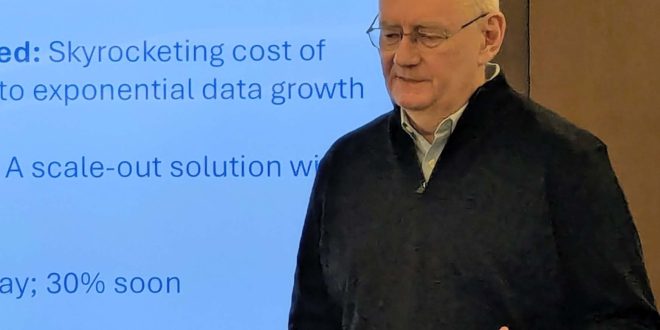
When Cesary Dubnicki spoke to us recently, he did not begin with a product pitch. Instead, he told stories about missed opportunities with Amazon and Google, about Princeton research in the 1990s, and about the long arc of storage technology. He is less about selling and more about explaining how a niche but critical segment of enterprise infrastructure has evolved, and why continuity matters for customers who cannot afford disruption.
Dubnicki is the founder of 9LivesData, a Warsaw-based company with roots in NEC’s Princeton research labs. His career has spanned the United States, Japan, and Europe, and he has spent more than two decades immersed in secondary storage. “I had many different opportunities,” he recalled, “but I decided to stick with storage and work in storage – and now I’m here talking about this product.”
The product in question is High9stor, a software-defined backup storage system designed to reduce the total cost of ownership while maintaining compatibility with NEC’s HydraStore. For channel partners, the story is not simply about a new system but about how existing customers can continue to operate without being stranded by shifting vendor strategies.
The origins of 9LivesData lie in NEC’s decision to commercialise a research project called HydraStore. Dubnicki had led the architecture and algorithm design in Princeton, and when NEC wanted to convert the work into a commercial product, he returned to Poland to build a team that could deliver. “I told them, okay, I can do that, I can start a company, and I can productise this for you,” he said.
HydraStore became one of the first commercial-scale-out secondary storage systems with global deduplication. It scaled to thousands of nodes, storing exabytes of data across government and enterprise deployments worldwide. NEC eventually shifted the business to Japan, where HydraStore continues to be sold, but the Western market was left with fewer options.
That gap created the conditions for 9LivesData to step forward. “It is in the best interest of NEC that we make this product available,” Dubnicki explained. “We can take care of existing customers and overseas customers outside of Japan, so they really want us to succeed.”
The continuity theme runs throughout his ethos. He described how the new system is designed to be compatible with HydraStore, allowing nodes to be inserted into existing grids. He also emphasised the ability to prolong hardware life by mixing generations within a single pool. “In one grid, we can have three generations of hardware, and you don’t have to retire your nodes,” he said. “This also saves you money, because you prolong the usage of hardware.”
Cost, scale, and reliability
For channel partners, the technical challenges of secondary storage are familiar. Enterprises face a data avalanche, with backup infrastructure costs rising sharply. Performance bottlenecks, restore times, ransomware protection, and disaster recovery are all pressing concerns.
High9stor has a recurring subscription model tied to raw terabytes per month. Customers are billed based on capacity and time in use, with options for three‑ or five-year terms paid up front and one-year extensions thereafter. The structure is deliberately simple to understand and, according to Dubnicki, comes in at roughly 20% lower cost than competitive backup storage solutions.
Dubnicki frames the discussion around the total cost of ownership. “Our clients told us that reducing costs is very important to them,” he said. The system’s design reflects that priority: high-density one-unit servers with 12 drives, 20 terabytes each, yielding 240 terabytes per unit, with scalability up to 180 nodes with 43PB raw capacity.
The reduced footprint translates into lower power consumption and cooling requirements, while management is simplified by consolidating into a single pool.
He also highlights use. “We have customers operating with 95% storage utilisation, so it’s very stable,” he said. Competitors often struggle beyond 80%, but Dubnicki insists the system can maintain performance at higher thresholds.
Global deduplication continues to stand out as a key differentiator. Data is segmented into variable-sized blocks, with duplicates eliminated and unique blocks compressed. “Backup performance is high-speed,” he explained. “Restore speeds are also strong, thanks to the large number of spindles – the bigger the system, the faster the restore.”
Reliability stories punctuate his presentation. He recounts an incident where a fire suppression system malfunctioned, causing micro-vibrations that corrupted 70% of drives in a data centre. His team worked through the weekend to recover the data. “By Monday, we basically recovered all the data,” he said. “They were very happy, especially since all the systems lost data.”
Such anecdotes underscore the stakes for customers. Backup storage is not glamorous, but when it fails, the consequences are severe.
Continuity for the channel
Dubnicki positions High9stor as a bridge. It is software-defined, allowing customers to use commodity hardware from vendors. It is compatible with HydraStore, ensuring migration paths for existing installations, and it is designed to meet Western expectations for flexibility and cost efficiency.
He is candid about the complexities. Deduplication across multiple backup applications requires careful management of metadata and placeholders; restore performance hinges on balancing drive sizes with spindle counts, and encryption decisions determine whether deduplication can cross tenant boundaries. The emphasis, however, is on practical solutions rather than theoretical elegance. “We don’t want users to replace their backup applications,” he said. “Our priority is ensuring business continuity.”
For managed service providers, multi-tenancy is a key consideration. Dubnicki noted that deduplication can cross user boundaries unless encryption is enforced. “If you start encrypting data with different keys, then obviously not,” he explained. The system supports isolation when required, while also delivering efficiency when customers accept shared deduplication domains.
The broader vision is to push toward standardisation. “Each backup application works differently with backup storage,” he said. “It would be nice to standardise this and basically make integration much easier, but obviously, this requires effort from many different players, not only us.”
A new product, an old responsibility
9LivesData plans to extend High9stor with a series of enhancements aimed at efficiency and resilience. Near-term goals include modifying existing systems to cut power consumption by up to 50%, delivering client-side S3 deduplication, and releasing an archive-focused version certified with additional backup and archiving applications. The roadmap also anticipates support for multi-actuator drives as larger capacities become available. Long-term, the company is preparing a next-generation platform built on QLC NVMe SSDs, offering much higher performance and density while keeping TCO comparable to current HDD-based systems. Alongside hardware advances, 9LivesData is working with backup software vendors to standardise interactions, such as metadata-only copy and integrated WORM/replication, so that enterprises can achieve smoother integration and more predictable operations.
In conclusion, customers cannot be left without options when vendors shift strategy. High9stor is positioned as a continuation to ensure that existing HydraStore users can migrate without disruption and that new customers can adopt a system designed for efficiency and resilience.
“We would like to deliver secondary storage, but in a software-defined model,” Dubnicki said. “It’s a large-scale system that can hold all enterprise backups while delivering very low TCO. And in terms of vision, we aim to become a recognised player in this market with an efficient solution.”
For partners, the opportunity lies not in selling a shiny new product but in maintaining trust with customers who depend on backup storage to protect their most critical data. Continuity, in this case, is not just a technical feature; it is the foundation of the relationship between vendor, channel, and enterprise.