 PCR Tech and IT retail, distribution and vendor news
Born from 12 years of disaster‑recovery experience, Cybee is positioning itself as a European alternative to legacy backup vendors built on OpenStack, driven by open formats, and designed for a world where recovery matters more than backup.
Cybee’s story begins long before its official launch in December 2022. Founder and CEO Eric Deronzier spent more than a decade building and operating cloud‑based disaster recovery platforms, but was frustrated with legacy vendors, hyperscaler lock‑in and the rising urgency of cyber resilience. “We don’t want to be dependent on one cloud supplier or cloud provider,” he says, referring to the company’s ethos.
That ethos is rooted in Deronzier’s earlier consultancy work. In the early 2000s he ran a firm specialising in risk management and business continuity planning for SMEs. Those customers needed resilience, but the only options were heavyweight data recovery (DR) platforms from IBM, HP or SunGard – solutions priced far beyond the reach of smaller organisations. When AWS arrived in Europe, Deronzier tested the idea of cloud‑based DR. The proof of concept worked technically, but he saw the same vendor lock‑in patterns he had spent years trying to avoid. That moment pushed him toward OpenStack, and by 2014 he had built his first cloud DR solution on Europe’s earliest OpenStack public cloud.
European cloud sovereignty is rising, hyperscalers still dominate 70% of the market, and customers increasingly want their last line of defence stored on a platform other than an American one. Cybee’s OpenStack‑based architecture gives them that choice.
The company’s technical direction changed again as its DR business began to scale. Larger customers brought larger datasets, and the team realised their existing backup engine – CloudBerry Lab, later MSP360 – could not meet the performance demands. They began testing alternatives and discovered Restic, an open‑source backup engine developed by German researchers. “We found the backup motorisation very, very, efficient,” Deronzier emphasises, but Restic was only an engine. It lacked the orchestration, image‑level backup, database handling and enterprise‑grade tooling required for real‑world DR. Cybee was created to build everything around that engine.
The result is a cloud‑native backup and recovery platform built entirely on microservices, written largely in Rust, and designed to handle both Windows and Linux workloads with a single agent. One customer is said to operate a single filer containing 63 million files. “No standard solution would be able to back up such a large amount of data,” Deronzier says. With Cybee, daily snapshots take three hours, and a full recovery takes under ten hours. Another customer saw incremental backups drop from more than 24 hours to a weekly cycle that actually completes. These are not theoretical benchmarks; they are production deployments.
Recovery speed is a recurring theme. Cybee’s engineering team claims restoration rates of around 4TB per disk per hour using high‑performance cloud SSD tiers. Deronzier says this is roughly ten times faster than what they observed with traditional backup vendors. For organisations facing ransomware – and Cybee has supported customers through complete infrastructure loss – this speed is not a luxury. “All is destroyed… help!” he recalls a customer saying after attackers encrypted production systems and wiped all local and remote backups. Cybee was able to rebuild the environment because its encryption keys were stored externally in a vault rather than within the customer’s compromised infrastructure.
This separation of keys is part of Cybee’s wider focus on immutability. The platform supports object lock and other mechanisms to ensure backups cannot be altered or deleted, even by an attacker with administrative access. It also uses open formats, which Deronzier argues will become essential as European regulations evolve. Proprietary backup formats make long‑term reversibility almost impossible, especially for banks that must be able to restore data from a decade ago.
The regulatory landscape is clearly shaping Cybee’s roadmap. NIS2 requires organisations to prove they can perform regular recovery tests. DORA, aimed at financial institutions, focuses entirely on the ability to restore business operations within defined recovery time objectives. These frameworks shift the conversation from backup to recovery – exactly the shift Cybee was built for. Deronzier notes that many legacy vendors still talk only about backup, not restoration, and that this gap will become increasingly untenable.
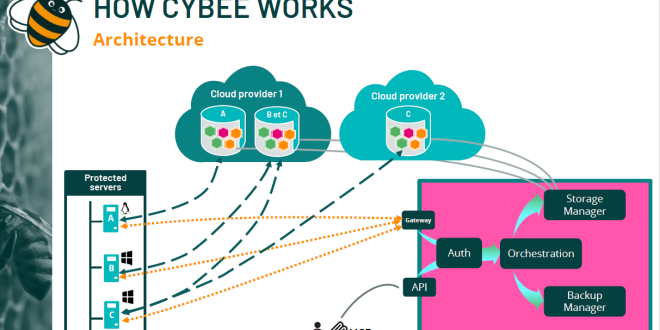
Cybee’s architecture reflects this recovery‑first mindset. The platform consists of two layers: a data layer, where encrypted and deduplicated backups are written directly to S3‑compatible storage, and a control layer built on Kubernetes. The control plane uses open‑source components: “100% of the solution is not dependent on private technology,” Deronzier says. The company plans to open‑source parts of its stack in future, starting with its Windows image‑backup engine, which extends Restic beyond file‑level backup.
Cybee’s first major rollout is through Nuabee, which has around 150 customers and more than 2,000 critical VMs under protection. This gives Cybee a substantial real‑world testbed before expanding to MSPs across France and, later, Europe. Orange Business will add Cybee to its existing distribution contract, giving the startup access to one of the region’s largest enterprise channels.
Cybee’s competitive landscape is familiar: Veeam, Commvault, Acronis and Rubrik dominate the mid‑to‑large enterprise market. Deronzier notes that around 80% of Nuabee’s customers use Veeam on‑prem. Cybee is not trying to replace those platforms immediately. Instead, it positions itself as an additional cyber‑resilience layer – a cloud‑native complement that provides immutable, sovereign, OpenStack‑based recovery capabilities. Over time, some customers retire their legacy backup systems once they have confidence in Cybee.
The roadmap is pragmatic. The platform already supports Windows image backup, Linux and Windows file backup, and API‑driven orchestration. Database‑specific modules are coming next, followed by support for Proxmox. VMware and Hyper‑V are not priorities, partly due to cost and partly because Cybee is targeting organisations with 200 to 10,000 employees – a sector where hybrid infrastructures and mixed hypervisors are common.
This is a company formed by lived experience rather than theory. Cybee is not trying to out‑market the incumbents; it is trying to solve problems that those incumbents were never designed to address. The rise of ransomware, the complexity of hybrid environments, the regulatory move toward demonstrable recovery, and the European push for cloud sovereignty all create a space where a cloud‑native, OpenStack‑aligned, recovery‑focused platform can thrive.
Cybee is small, family‑run and deeply technical, but it is already operating at a scale that many startups never reach. It has real customers, real failures it has helped recover from, and real performance metrics that differentiate it from traditional backup vendors. It is also part of a broader movement: American firms are building Restic‑based products too, though they remain largely unknown in Europe. Cybee sees this as validation, not competition.
For the channel, Cybee represents a European‑built alternative in a market dominated by US vendors, designed for MSPs, aligned with emerging regulations, and built for a world where recovery is the metric that matters.