 PCR Tech and IT retail, distribution and vendor news
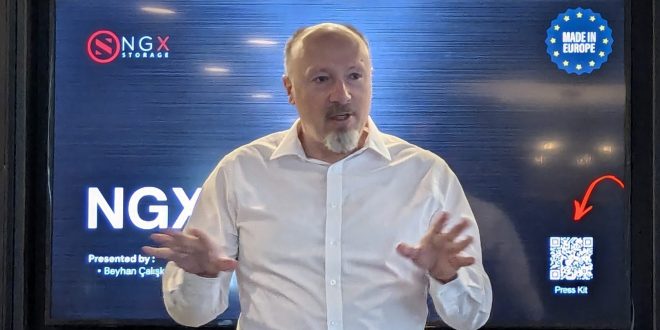
NGX Storage’s CEO and founder, Beyhan Çalışkan, outlines how a Turkish‑born storage vendor has grown into a multi‑continent player with unified systems, exascale ambitions, and a firm belief that storage should be simple, even when the workloads aren’t.
When Beyhan Çalışkan left Türkiye’s National Research Institute in 2015, he took with him a single idea: enterprise storage had become far too complicated. Administrators were juggling block, file, object, backup, archive, and AI workloads across fragmented systems, each with its own quirks, limits, and management overhead. NGX Storage was founded to bring that sprawl into something unified, predictable and, above all, simple.
A decade later, NGX is shipping petabyte‑scale systems into telcos, government ministries, aerospace programmes, research institutions, and large enterprises across Europe, the Middle East, and Asia. The company now operates R&D centres in Türkiye and India, has deployments in Poland, Malaysia, South Korea, and the UAE, and is preparing to enter Western Europe. It has grown organically, without external investment beyond an initial seed round, and now employs around 100 engineers across its ecosystem.
For a vendor that began life in Ankara with a handful of engineers and a belief that storage should “just work,” NGX has become one of the region’s more unusual success stories: a home‑grown, high‑performance storage company competing directly with well-established brands, often in highly regulated or sovereignty‑sensitive environments.
A unified approach in a fragmented market
Çalışkan’s core idea is that storage complexity is a tax on innovation. “Storage should be simple,” he says. “Administrators should not be dealing with complex problems just to manage data.” NGX’s answer is a unified architecture that supports block, file, and object workloads within a single system, with consistent management, consistent performance expectations, and a consistent operational model.
The company’s product family spans hybrid arrays, all‑flash systems, and a new exascale‑class NVMe platform designed for AI and high‑performance workloads. All share the same software base, with optimisations applied depending on the use case.
Hybrid systems remain NGX’s most widely deployed products, particularly in telco environments where large‑scale unstructured data and regulatory workloads dominate. These systems combine SSDs and nearline SAS drives and scale to 38PB under a dual‑controller architecture. NGX emphasises ease of deployment: “You can launch the system in five minutes once the physical installation is complete,” Çalışkan says. “We don’t want to waste time.”
The company’s all‑flash line supports storage‑class memory, TLC and QLC NVMe SSDs, and SAS expansion shelves, scaling up to 34PB per system. NGX primarily uses enterprise‑grade dual‑port SSDs, with vendor selection depending on workload and platform.
Across both hybrid and all‑flash platforms, NGX supports inline compression, deduplication, thin provisioning, zero‑detection, and a wide range of RAID and mirroring schemes, including triple mirroring and four‑way mirroring for metro‑cluster deployments.
Workload‑specific tuning is a recurring theme. NGX aligns block sizes to application needs, such as 8KB for Oracle, 16KB for MySQL, and 1MB for vector search engines, optimising throughput and reducing unnecessary write amplification. Customers span VMware, KVM, Proxmox, OpenStack, and cloud‑native environments, with PostgreSQL and Oracle among the most common database workloads.
Exascale ambitions and the AI wave
The most significant shift in NGX’s roadmap is its move into exascale‑class NVMe storage. The new platform, software‑defined, scale‑out, and built for AI, HPC, and high‑throughput analytics, marks a strategic expansion beyond traditional unified storage.
NGX’s exascale system is an end‑to‑end NVMe architecture using RDMA (RoCEv2) for low‑latency communication between nodes. The platform is hardware‑agnostic: customers can deploy it on certified servers from Supermicro and IES, with ASUS and others to come soon. This software‑only model is central to NGX’s expansion strategy. Hardware regulations vary widely across regions; India, the UK, the EU, and Türkiye all have different compliance frameworks, so decoupling software from hardware accelerates market entry.
The system supports 100GbE today and will support 200GbE and 400GbE as PCIe Gen5 and Gen6 servers become mainstream. NGX emphasises that customers can upgrade nodes in place: shut down a node, replace the server, move the drives, and rejoin the cluster. “With a live system, they can increase performance and create a new generation of storage workload,” Çalışkan says.
AI is a major driver. Training and inference workloads require massive parallel access to NVMe, and NGX positions its exascale platform as a high‑performance block layer for AI frameworks, cache layers, or cluster file systems.
A regional player with global intent
NGX’s customer base spans telcos, government agencies, aerospace programmes, oil and gas companies, healthcare providers, and research institutions. In Türkiye, the company supplies storage to the presidency, multiple ministries, and major telcos.
In Europe, NGX has a strong presence in Poland and is also active in Malaysia, South Korea, and the UAE, with deployments often delivered through OEM partners.
The company is also preparing to open a European manufacturing site, most likely in Bulgaria or Poland, to support EU demand and align with ‘Made in Europe’ frameworks. Although Türkiye is not an EU member, it participates in the customs union, easing trade and logistics.
Data sovereignty is a recurring theme. Çalışkan argues that governments and enterprises increasingly want local control over data, particularly in healthcare and finance. “A hospital worker can write your data to search engines,” he says. “All my data is going to the United States or someone else, and they are profiling you.” NGX positions itself as a European‑aligned alternative to US and Chinese vendors, offering local support, local manufacturing, and integration with European cloud and AI initiatives.
Engineering depth and organic growth
NGX’s engineering team is split between Türkiye and India, with R&D centres in Ankara, Istanbul, Pune, and Bangalore. Many Indian engineers previously worked at NetApp, IBM, Oracle, and Dell. The company’s early work included contributions to SPDK, RDMA networking, and OpenStack drivers, and NGX maintains close relationships with semiconductor vendors such as Kioxia.
Despite its growth, NGX remains privately held. After the initial seed investment, the company has expanded organically, with claimed growth of between 80% and 300% annually, depending on economic conditions. Çalışkan does not disclose revenue but says NGX is “one of the top players in our region”.
The company ships roughly one petabyte of storage per customer on average, though smaller configurations, such as 250TB and 500TB, are available. NGX does not target the SMB market; its focus is on large enterprises and service providers with demanding workloads and long‑term data retention needs.
A vendor to watch in the channel
For channel partners, NGX presents an interesting proposition: a unified storage vendor with a broad portfolio, strong engineering pedigree, and a growing footprint across Europe and Asia. Its software‑defined exascale platform opens opportunities in AI, HPC, and cloud‑scale environments, while its hybrid and all‑flash systems address mainstream enterprise workloads.
The company’s emphasis on simplicity, rapid deployment, and unified management will appeal to partners looking to reduce integration overheads. Its regional manufacturing plans and data‑sovereignty positioning align well with European public‑sector and regulated‑industry requirements.
NGX is not yet a household name in Western Europe, but its expansion plans, combined with its existing deployments in Poland and the Middle East, suggests a vendor preparing for a broader push. For partners seeking alternatives to the dominant US and Chinese storage suppliers, particularly in sovereignty‑sensitive markets, NGX may be one to watch.
