 PCR Tech and IT retail, distribution and vendor news
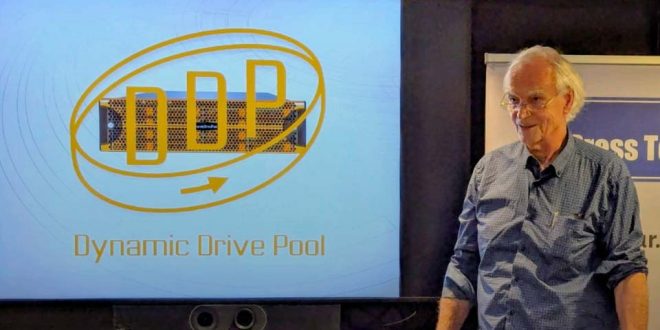
In media production, storage systems must handle large files, fast workflows, and tight collaboration. Dynamic Drive Pool (DDP) by Ardis Technologies is built specifically for these demands, offering a file system and architecture tailored to the realities of post-production and broadcast environments. CEO Jan de Wit explains.
In the media and entertainment (M&E) sector, where high-resolution content and collaborative workflows place significant demands on storage infrastructure, Dynamic Drive Pool (DDP) by Ardis Technologies presents a purpose-built approach to shared storage. Developed in the Netherlands, DDP is specifically designed for M&E environments, with a proprietary file system and Ethernet SAN architecture that diverges from more commonly adopted solutions.
Ardis Technologies operates with a small team and distributes DDP systems both directly and through regional partners. “We have six people on staff,” says CEO Jan de Wit, “and we have distributors in Asia, the Middle East, the United States and Europe.” The company’s focus remains narrow: shared storage for M&E workflows, without bundling asset management systems or cloud services. “We stick to what we do best,” he adds, “and that’s a shared storage file system with AVFS.”
The Ardis Virtual File System (AVFS) is central to DDP’s architecture. Developed in-house, AVFS supports raw block-level access and incorporates a project caching layer that is file- and folder-aware. This design enables simultaneous use of SSDs and HDDs within a unified namespace, allowing active media to be accessed from SSDs while maintaining mirrored copies on spinning disks. “You can import material into the SSD cache,” de Wit explains, “and once a file is in the cache, it is automatically copied over to the spindles. So you already have two copies.”
This dual-path structure is managed at the index node (inode) level, with AVFS maintaining consistent metadata and directory trees regardless of the underlying storage tier. “Each inode can have two paths,” de Wit says, “and that’s unique to AVFS.” The system’s caching mechanism is intended to balance performance and capacity, particularly in environments where SSD-only configurations may be cost-prohibitive. “Even small companies need hundreds of terabytes of capacity,” he notes. “For an all-SSD system in M&E, that’s basically too expensive.”
AVFS also supports folder-level volume mapping, enabling administrators to assign volume properties to any folder and mount it as a discrete volume on Mac, Windows, or Linux desktops. “We give each folder volume properties,” de Wit says, “so they can be connected or mounted as a volume on the desktop.” This allows for granular access control across collaborative teams. “One operator can access audio, another video, and another both,” he adds, “and it can be instantly changed.”
The system’s internal data movement capabilities allow files to be relocated across SSDs, HDDs, or tape without altering the directory structure or access permissions. “The file system is kept independently of where the data is stored,” de Wit says. “This creates the possibility to move data around internally between all these groups without basically changing anything.”
Security features include HTTPS access, two-factor authentication, and folder-level permissions. DDP systems can authenticate users via domain controllers and include audit utilities for tracking user actions. Physical access is restricted through dual-key front bezels, and optional inline encryption is available for both SSDs and HDDs. De Wit emphasises that responsibility for media security remains with the storage operator, particularly when cloud services are involved. “If Company A stores media from Company B onto the cloud,” he says, “then Company A remains responsible.”
DDP systems are designed for on-premise deployment, with support for air-gapped workflows and transfer rooms for import and export. This configuration is intended to reduce exposure to external threats while maintaining performance. “We found that many of our customers look at cloud and then try to do something with it,” de Wit says, “but they forget that they remain responsible for the media’s security.”
Performance varies by model. The DDP10EF, for example, delivers up to 40GB/s of bandwidth and supports NVMe over Fabric (NVMe-oF) with RDMA. “This small one-U box has a bandwidth of 40 gigabytes per second,” de Wit says. “Each connected workstation can have a bandwidth of 11GB/s.” This level of throughput supports multiple 8K DPX streams, which are common in high-end post-production environments.
Pricing ranges from €14,000 for entry-level microDDPs to €500,000 for high-availability configurations. The average sale price is approximately €17,000. All systems run the same AVFS software stack, regardless of size or capacity. “Even our smallest system runs the same software as our biggest,” de Wit says. “You can have hundreds of hours of camera material on this box and still work simultaneously.”
DDP systems are used across a range of M&E applications, including mobile production units, university media labs, and national broadcasters. According to the case studies on the company’s website, Jan Miltenburg of Miltenburg AV described using microDDP units for live events: “We use it for big pop festivals, concerts, award events, and football games. A great environment for the microDDP.” At Northumbria University, DDP supports automated student access and quota management. “Our students can just log in on any machine using their standard university ID,” said Alexander Harbord, “and their drive appears on the desktop.”
The management interface is web-based and designed for ease of use, allowing administrators to assign volumes, monitor performance, and manage quotas without specialised training. “We want to keep it as simple as possible for our customers,” de Wit says, “so they don’t need an IT operator to manage the system.”
DDP’s architecture differs from competitors that rely on third-party file systems or integrate asset management tools. “Eight out of 12 competitors use one or more third-party file systems,” de Wit notes. “They didn’t make the leap we made.” By focusing solely on storage and file system development, Ardis Technologies maintains control over the full stack. “For us, it’s easy,” he says. “We know everything so that we can deal with anything quickly and easily.”
While DDP does not include cloud or AI features natively, its performance characteristics allow integration with external systems. “We are cloud and AI ready because of our high performance,” de Wit says, “but we don’t need to implement cloud pathways or AI tools ourselves.” Customers can select their own asset management and AI platforms, with DDP providing the underlying storage infrastructure.
DDP’s design indicates a deliberate choice to specialise in M&E storage rather than expand into adjacent markets. Its AVFS file system, caching architecture, and Ethernet SAN model are tailored to the sector’s workflow requirements. Asked why they don’t expand, de Wit simply says: “We like this sector because it’s informal, it’s not a suit business.”